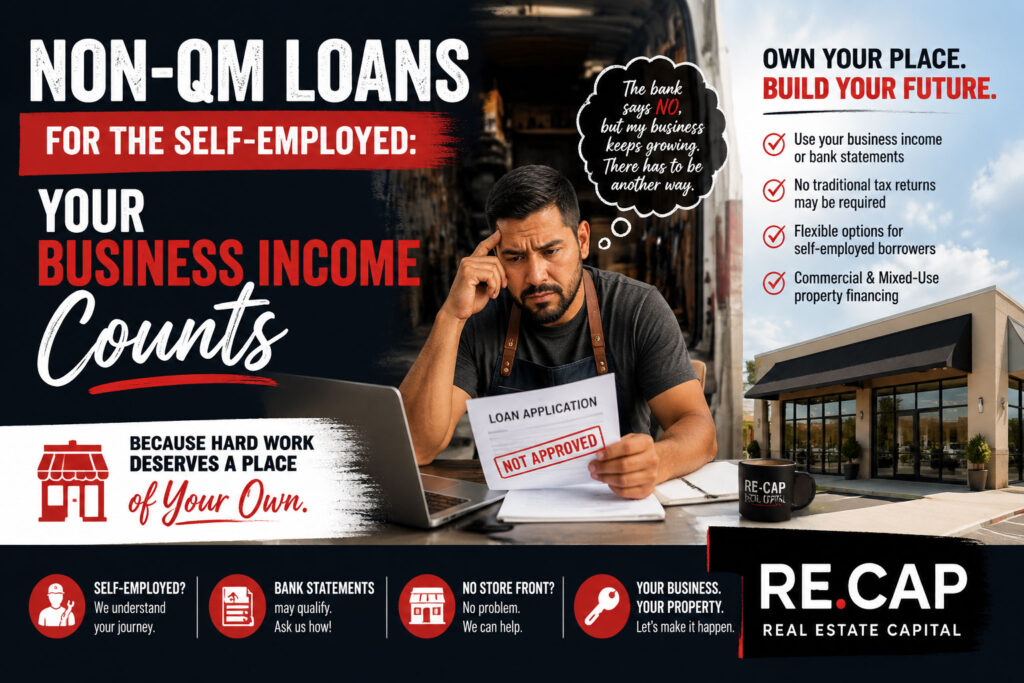
Running your own business takes courage.
Whether you’re a mobile mechanic in Katy, a landscaper in Cypress, a cleaning service owner in Pearland, a food truck operator in Pasadena, or a contractor serving clients throughout Houston, you’ve worked hard to build something of your own.
But when it’s time to buy a commercial property or a mixed-use building where you can operate your business, many self-employed entrepreneurs discover an unexpected obstacle.
The bank says your income isn’t enough.
That can be confusing because your business is profitable, your clients keep coming back, and your bank account shows consistent deposits.
So why does the mortgage application say otherwise?
The answer often comes down to how traditional mortgage lenders evaluate income—not necessarily how successful your business really is.
Fortunately, Non-QM (Non-Qualified Mortgage) loans were created to help borrowers whose financial situation doesn’t fit conventional lending guidelines.
Why Traditional Loans Can Be Difficult for Self-Employed Borrowers
Traditional mortgages generally rely on taxable income reported on federal tax returns.
Many small business owners legally reduce their taxable income by deducting legitimate business expenses, such as:
- Equipment
- Vehicle expenses
- Office supplies
- Insurance
- Advertising
- Professional services
These deductions are encouraged under the U.S. tax code, but they can make your reported taxable income appear much lower than your actual cash flow.
As a result, you may earn enough to comfortably make mortgage payments while still appearing to earn too little according to conventional underwriting standards.
The Consumer Financial Protection Bureau (CFPB) explains that lenders must evaluate a borrower’s ability to repay, but different loan programs may use different methods to document income depending on the loan type.
Source: Consumer Financial Protection Bureau – Ability-to-Repay and Qualified Mortgage Rule
What Is a Non-QM Loan?
A Non-Qualified Mortgage (Non-QM) is a home loan that does not meet the specific underwriting standards established for Qualified Mortgages under the CFPB’s Ability-to-Repay rule.
This does not mean the loan is unsafe or “subprime.”
Instead, it means lenders can use alternative documentation to verify a borrower’s ability to repay, provided they comply with federal lending regulations.
The CFPB confirms that Non-QM loans remain subject to the Ability-to-Repay requirements.
Source: Consumer Financial Protection Bureau – Ability-to-Repay and Qualified Mortgage Standards
Your Business Income May Help You Qualify
One of the biggest advantages of many Non-QM programs is that they may allow lenders to evaluate income differently than conventional mortgages.
Depending on the loan program and lender guidelines, qualifying documentation may include:
- Business bank statements
- Personal bank statements
- Profit and Loss (P&L) statements prepared according to lender requirements
- CPA-prepared financial documentation
- Asset-based documentation in certain situations
Each lender has its own underwriting requirements, and documentation standards vary by program.
Because of this, approval is never guaranteed.
What If You Don’t Have a Traditional Office?
Many successful businesses don’t operate from a commercial storefront.
You might work from:
- Your home
- Customer locations
- A vehicle
- Shared workspaces
- Temporary job sites
Having no physical storefront does not automatically prevent you from applying for financing.
Lenders are generally more concerned with documenting stable income, verifying your business operations, reviewing your credit profile, and evaluating the property being financed than whether your business has a retail location.
Exact requirements vary by lender and loan program.
Buying a Place for Your Growing Business
As your business grows, renting space or working from home may no longer be the best long-term solution.
Owning your own property can offer benefits such as:
- More control over your workspace
- Stable monthly occupancy costs compared with rising rents
- Room for future expansion
- Building long-term equity through property ownership
However, whether purchasing a commercial property, mixed-use building, or another type of real estate is appropriate depends on your business goals, financial situation, and the loan program available.
A lending professional can explain which financing options fit your circumstances.
Common Businesses That May Benefit from Non-QM Financing
Many self-employed professionals have income that doesn’t fit traditional lending models.
Examples include:
- General contractors
- Electricians
- Plumbers
- Mobile mechanics
- Truck owners
- Cleaning companies
- Landscapers
- Independent consultants
- Realtors
- Freelancers
- Photographers
- Beauty professionals
- Food truck operators
- Online business owners
- Independent sales professionals
Eligibility always depends on the lender’s underwriting guidelines and your overall financial profile.
What Lenders Typically Review
While every lender has different requirements, many Non-QM loan programs evaluate several factors, including:
- Credit history
- Cash flow documentation
- Bank statements
- Down payment
- Property type
- Business stability
- Assets and reserves, where applicable
Meeting one requirement alone does not guarantee approval.
Serving Houston and Its Surrounding Communities
At RecapHTX, we understand that entrepreneurs often build successful businesses outside of traditional employment.
Whether your business serves customers in:
- Katy
- Cypress
- Sugar Land
- Pearland
- Richmond
- Rosenberg
- Missouri City
- Spring
- Tomball
- The Woodlands
- League City
- Friendswood
- Humble
- Baytown
our team can help explain financing options that may better fit self-employed borrowers.
Every borrower’s situation is unique, and we’ll help you understand what documentation may be required based on your goals.
Ready to Explore Your Options?
Being self-employed shouldn’t automatically mean giving up on your dream of owning a property for your business.
If your income is strong but traditional mortgage guidelines don’t reflect your financial reality, a Non-QM loan may be worth exploring.
The first step is simply having a conversation.
Our team can review your situation, explain the available loan options, and help you understand which documentation may be appropriate for your circumstances—without pressure or obligation.
Contact RecapHTX today to learn whether a Non-QM loan could help you move your business into a place you can truly call your own.
Frequently Asked Questions
Can I qualify for a Non-QM loan if I’m self-employed?
Possibly. Many Non-QM programs are designed for borrowers who cannot qualify through traditional income documentation. Approval depends on the lender’s underwriting requirements, your financial profile, and the documentation you provide.
Do I need a commercial storefront?
Not necessarily. Many self-employed borrowers operate from home, job sites, or mobile businesses. Lenders generally focus on documenting income, creditworthiness, and repayment ability rather than requiring a physical storefront.
Are Non-QM loans only for business owners?
No. Non-QM loans may also be appropriate for borrowers with non-traditional income, real estate investors, retirees with significant assets, or others who don’t fit conventional mortgage guidelines.
Are Non-QM loans regulated?
Yes. Non-QM loans remain subject to the federal Ability-to-Repay (ATR) requirements established by the Consumer Financial Protection Bureau.
Sources
- Consumer Financial Protection Bureau (CFPB). Ability-to-Repay and Qualified Mortgage Standards. https://www.consumerfinance.gov/compliance/compliance-resources/mortgage-resources/ability-to-repay-qualified-mortgage-rule/
- Consumer Financial Protection Bureau (CFPB). Ability-to-Repay and Qualified Mortgage Small Entity Compliance Guide. https://files.consumerfinance.gov/f/documents/cfpb_ability-to-repay-qualified-mortgage_small-entity-compliance-guide.pdf
- Internal Revenue Service (IRS). Business Expenses. https://www.irs.gov/businesses/small-businesses-self-employed/deducting-business-expenses
- Federal Housing Finance Agency (FHFA). Mortgage and Housing Market Resources. https://www.fhfa.gov
Disclaimer: This article is for educational purposes only and should not be considered legal, tax, or financial advice. Loan eligibility, documentation requirements, interest rates, and underwriting standards vary by lender and loan program. RecapHTX cannot guarantee approval. Please consult a qualified mortgage professional, tax advisor, or attorney regarding your specific circumstances.