
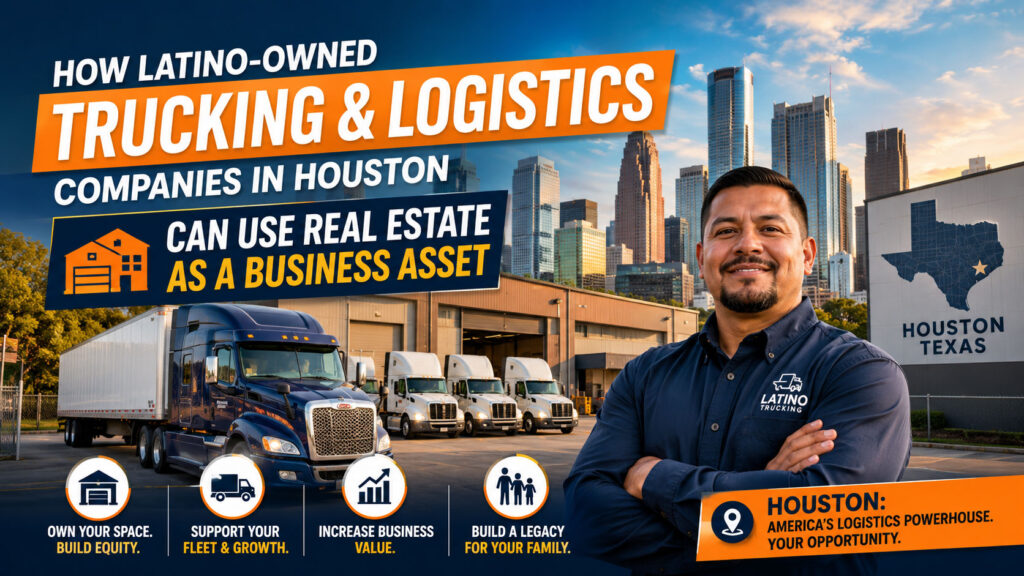
Building More Than a Trucking Business
Many Latino entrepreneurs in Houston have spent years building successful trucking and logistics companies from the ground up. They started with one truck, added drivers, expanded their customer base, and built businesses through hard work and determination.
However, many business owners continue paying rent for truck yards, warehouses, maintenance facilities, or office space without considering another option: owning the real estate their business depends on.
For trucking companies that have reached a stable stage of growth, commercial real estate can become more than just a place to park trucks. It can become a long-term business asset that supports growth, builds equity, and provides additional financial flexibility.
This article explains how Houston trucking and logistics companies can use commercial real estate strategically, based on verified information from industry and government sources.
Why Houston Remains One of America’s Strongest Logistics Markets
Houston is one of the nation’s largest transportation and logistics hubs because of several long-term economic advantages.
These include:
- Access to the Houston Ship Channel
- Extensive interstate highway network
- Major rail connections
- Two international airports
- Large manufacturing and petrochemical industries
- Strong population growth that increases demand for freight movement
According to Port Houston, thousands of acres of industrial land, terminals, and logistics facilities support businesses moving cargo through the region. Port Houston also offers industrial lease opportunities and Foreign Trade Zone locations for qualifying businesses.
Industry analysis from Link Logistics identifies three primary drivers of Houston’s industrial market:
- Population growth
- Port activity
- Petrochemical production
Together, these factors create sustained demand for warehouse space, distribution facilities, trucking services, and logistics operations.
Why Renting Forever Can Limit Growth
Renting commercial space is often the right choice for new businesses.
However, as companies mature, continually paying rent may present challenges.
Some common issues include:
- Annual rent increases
- Lease renewal uncertainty
- Limited control over property improvements
- Restrictions on truck parking or outdoor storage
- Lack of equity accumulation
When lease payments stop, the business owns nothing from those years of occupancy.
Owning commercial property changes that equation because each mortgage payment may contribute toward ownership, depending on financing structure.
Real Estate Can Become a Business Asset
Commercial real estate serves two purposes.
-
It Supports Daily Operations
Examples include:
- Truck parking
- Trailer storage
- Fleet maintenance
- Dispatch offices
- Driver facilities
- Warehousing
- Cross-docking
Owning a facility gives businesses greater control over how the property is used, subject to local zoning and regulations.
-
It Can Build Long-Term Business Equity
Unlike lease payments, owned real estate may appreciate in value over time, although appreciation is never guaranteed.
The property itself may become an asset on the company’s balance sheet while providing operational stability.
Business owners should understand that commercial real estate values can rise or fall depending on market conditions, location, property condition, and economic factors.
Types of Commercial Properties Trucking Companies Often Consider
Depending on the business model, trucking companies may purchase or lease properties such as:
Industrial Outdoor Storage (IOS)
Often used for:
- Truck parking
- Trailer storage
- Container storage
- Equipment yards
Houston continues to see investment in Industrial Outdoor Storage properties because of demand from transportation and logistics operators.
Warehouses
Useful for:
- Freight consolidation
- Distribution
- Inventory storage
- Cross-docking
Houston continues to experience strong warehouse demand because of freight activity connected to Port Houston and regional distribution.
Maintenance Facilities
Some larger trucking companies purchase facilities with:
- Repair bays
- Fleet maintenance
- Parts storage
- Driver amenities
Purpose-built logistics facilities near Houston often include extensive trailer parking and maintenance capabilities.
Office + Yard Combinations
Many growing trucking companies prefer properties combining:
- Administrative offices
- Secure truck parking
- Equipment storage
- Warehouse space
This arrangement can improve operational efficiency by keeping dispatch, maintenance, and fleet operations in one location.
Financial Benefits of Owning Commercial Property
While every business is different, commercial property ownership may offer several advantages.
These can include:
- Greater control over occupancy costs
- Potential equity growth through loan repayment
- Possible appreciation in property value (not guaranteed)
- Ability to customize facilities for operational needs
- Potential rental income if excess space is leased to another business
Tax treatment varies depending on ownership structure and individual circumstances. Business owners should consult a qualified CPA or tax professional before making decisions.
SBA Financing May Help Eligible Businesses Purchase Property
Some owner-occupied commercial properties may qualify for financing through the SBA 504 Loan Program or the SBA 7(a) Loan Program, depending on eligibility requirements and lender approval.
The SBA states that these programs can be used for eligible owner-occupied commercial real estate purchases under program guidelines. Business owners should review current requirements with participating lenders because eligibility, occupancy, and financing terms vary.
Choosing the Right Location in Houston
Location matters just as much as the building itself.
Many trucking companies evaluate areas based on:
- Access to Interstate 10
- Interstate 45
- Beltway 8
- Highway 225
- State Highway 146
- Proximity to Port Houston
- Rail access
- Customer locations
- Driver commute times
Properties near major freight corridors often reduce travel time and improve operational efficiency.
Questions to Ask Before Buying
Before purchasing commercial property, business owners should evaluate:
- Is the property properly zoned?
- Can it accommodate future fleet growth?
- Is truck access adequate?
- Are environmental issues present?
- What improvements are needed?
- What are ongoing maintenance costs?
- Does the property meet insurance requirements?
A commercial real estate broker, lender, attorney, and environmental consultant can help evaluate these issues during due diligence.
Real Estate Can Help Build a Family Legacy
Many Latino entrepreneurs build businesses not only for today’s income but also for future generations.
Owning commercial property may contribute to that long-term vision by creating a business asset that can continue supporting operations or generating value beyond the current owner’s career.
However, commercial real estate is a significant investment and involves financial risk. Careful planning, professional advice, and thorough due diligence remain essential before purchasing any property.
Final Thoughts
Houston continues to be one of the strongest logistics markets in the United States, supported by its port, transportation infrastructure, manufacturing base, and growing population. These long-term fundamentals help sustain demand for industrial properties used by trucking and logistics companies.
For Latino-owned trucking businesses that have achieved stable growth, purchasing commercial real estate may offer advantages such as operational control, the opportunity to build equity, and greater long-term stability. Whether a business is considering a truck yard, warehouse, maintenance facility, or office with outdoor storage, the decision should be based on financial readiness, business needs, and guidance from qualified professionals.
Owning the property where your business operates is not the right choice for every company—but for the right business at the right stage, it can become an important part of a long-term growth strategy.
Sources
- Port Houston – Real Estate and Development Opportunities: https://porthouston.com/business/become-a-customer/real-estate/
- Link Logistics – Houston Industrial Real Estate Market Overview (2026): https://www.linklogistics.com/news-insights/industry-expertise/houston-industrial-real-estate-port-driven-demand-petrochemical-hub/
- Rockefeller Group – East Bay Trade Center Logistics Development: https://www.rockefellergroup.com/news/rockefeller-group-and-falcon-commercial-development-break-ground-on-557k-sf-logistics-park-near-port-of-houston/
- Alterra IOS – Houston Industrial Outdoor Storage Market: https://www.businesswire.com/news/home/20240912472169/en/Alterra-IOS-Acquires-4-Industrial-Outdoor-Storage-Sites-in-Houston-MSA
- Dayton Street Partners – Houston Industrial Logistics Facility: https://dspre.com/new-owner-finds-tenant-for-500000-square-foot-industrial-facility-in-houston/