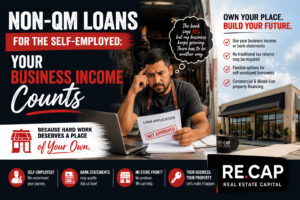

If you’re self-employed in Houston, you may earn a great income but still find it difficult to qualify for a traditional mortgage. The good news is that a “no” from one loan program doesn’t always mean you can’t buy a home. For many entrepreneurs, freelancers, contractors, and small business owners, a Non-QM loan may provide another path to homeownership.
Running a Successful Business Doesn’t Always Mean Qualifying for a Conventional Mortgage
Houston is home to thousands of entrepreneurs—from construction contractors and truck owners to restaurant operators, real estate professionals, healthcare consultants, and independent tradespeople.
Many of these business owners legitimately reduce their taxable income through deductions allowed by the IRS. While this is good tax planning, it can create an unexpected problem when applying for a traditional mortgage.
Conventional mortgages typically rely heavily on tax returns to calculate qualifying income. If your adjusted income appears lower because of business deductions, you may qualify for less than you can actually afford—even if your business has strong cash flow.
That is where Non-QM lending may become an option.
What Is a Non-QM Loan?
Non-QM stands for Non-Qualified Mortgage.
This does not mean the loan is unsafe or that borrowers are not evaluated carefully.
Instead, it means the mortgage does not meet the specific definition of a “Qualified Mortgage (QM)” established under federal lending regulations.
Importantly:
- Lenders must still evaluate your ability to repay the loan.
- Income and assets must still be documented.
- Underwriting standards still apply.
- The documentation methods are simply more flexible than those used for many conventional loans.
Who Are Non-QM Loans Designed For?
Non-QM loans may benefit borrowers whose financial situation doesn’t fit traditional mortgage guidelines.
Common examples include:
- Self-employed business owners
- Independent contractors
- 1099 workers
- Freelancers
- Gig economy workers
- Real estate investors
- Individuals with significant assets but complex income documentation
The Consumer Financial Protection Bureau (CFPB) notes that certain loan programs are marketed toward self-employed borrowers and those with non-traditional income documentation.
How Is Income Verified?
Unlike many conventional loans that primarily rely on tax returns, some Non-QM programs allow lenders to evaluate income using alternative documentation.
Depending on the lender and program, documentation may include:
Bank Statements
Many bank statement programs review 12 or 24 months of personal or business bank statements to estimate qualifying income rather than relying solely on tax returns.
Asset-Based Qualification
Some borrowers may qualify using eligible financial assets instead of traditional employment income.
Profit and Loss Statements
Certain programs may accept CPA-prepared or other qualifying financial documentation, subject to lender guidelines.
Every lender has its own underwriting requirements, so acceptable documentation varies.
Common Types of Non-QM Loans
Several loan products fall under the Non-QM category.
Bank Statement Loans
Popular among self-employed borrowers who have healthy cash flow but lower taxable income due to business deductions.
DSCR Loans
Primarily designed for real estate investors.
Instead of qualifying based on personal income, lenders evaluate whether the property’s rental income is sufficient to cover the mortgage payment.
Asset Utilization Loans
Borrowers with significant liquid assets or investments may qualify using those assets as evidence of repayment ability.
Availability depends on lender guidelines.
Advantages of Non-QM Loans
For the right borrower, Non-QM financing can provide valuable flexibility.
Potential benefits include:
- Flexible income documentation
- Options for self-employed borrowers
- May accommodate recent business growth
- Can work well for complex financial situations
- Available for certain investment properties
The primary advantage is that underwriting may better reflect how many entrepreneurs actually earn income.
Things to Consider Before Choosing a Non-QM Loan
A Non-QM loan is not automatically better than a conventional mortgage.
Borrowers should carefully compare all available options.
Depending on the lender and program, Non-QM loans may include:
- Higher interest rates
- Larger down payment requirements
- Additional reserve requirements
- Higher closing costs
- Prepayment penalties on some loan products
The CFPB recommends reviewing every Loan Estimate carefully and asking whether a comparable conventional loan is available before making a final decision.
Common Misconceptions About Non-QM Loans
“They’re the same as the risky loans before 2008.”
This is one of the biggest misconceptions.
Following the financial crisis, federal mortgage regulations changed significantly.
Today’s lenders must generally evaluate a borrower’s ability to repay under applicable federal rules. While Non-QM loans fall outside the Qualified Mortgage definition, they are still subject to underwriting standards and ability-to-repay requirements.
“You don’t need documentation.”
Not true.
Borrowers must still document their financial situation.
The difference is how income may be documented—not whether documentation is required.
“Anyone can qualify.”
Also false.
Each lender establishes its own underwriting guidelines.
Approval depends on multiple factors, including:
- Credit history
- Income documentation
- Down payment
- Cash reserves
- Property type
- Overall financial profile
Tips for Self-Employed Homebuyers in Houston
If you’re considering purchasing a home, preparing early can improve your financing options.
Helpful steps include:
- Keep business and personal finances organized.
- Maintain consistent bank deposits.
- Avoid large undocumented cash transactions.
- Keep business records current.
- Work with a CPA who understands mortgage documentation.
- Compare multiple lenders before selecting a loan program.
The CFPB also recommends obtaining Loan Estimates from several lenders so you can compare costs, rates, and loan features side by side.
Frequently Asked Questions
Can I qualify if I write off a lot of business expenses?
Possibly. Some Non-QM programs use alternative methods of documenting income, such as bank statements. Qualification depends on the lender’s underwriting guidelines and your overall financial profile.
Are Non-QM loans only for business owners?
No. They may also be used by certain investors, freelancers, independent contractors, retirees with substantial assets, and other borrowers whose income doesn’t fit conventional documentation requirements.
Are interest rates always higher?
Not always, but they are often higher than comparable conventional mortgages because these loans generally involve different underwriting considerations and are not eligible for purchase by government-sponsored enterprises such as Fannie Mae or Freddie Mac. Actual pricing depends on market conditions, credit profile, down payment, and lender policies.
Final Thoughts
Owning a successful business should not automatically prevent you from becoming a homeowner.
If your income doesn’t fit the traditional mortgage formula, a Non-QM loan may provide another financing option—provided it matches your financial goals and circumstances.
The most important step is understanding your options before making a decision. Comparing multiple loan programs, asking detailed questions, and reviewing official Loan Estimates can help you choose financing that fits both your budget and your long-term plans.
This article is for educational purposes only and should not be considered financial, tax, or legal advice. Mortgage guidelines vary by lender and may change over time. Always consult a licensed mortgage professional and your tax advisor regarding your specific situation.